
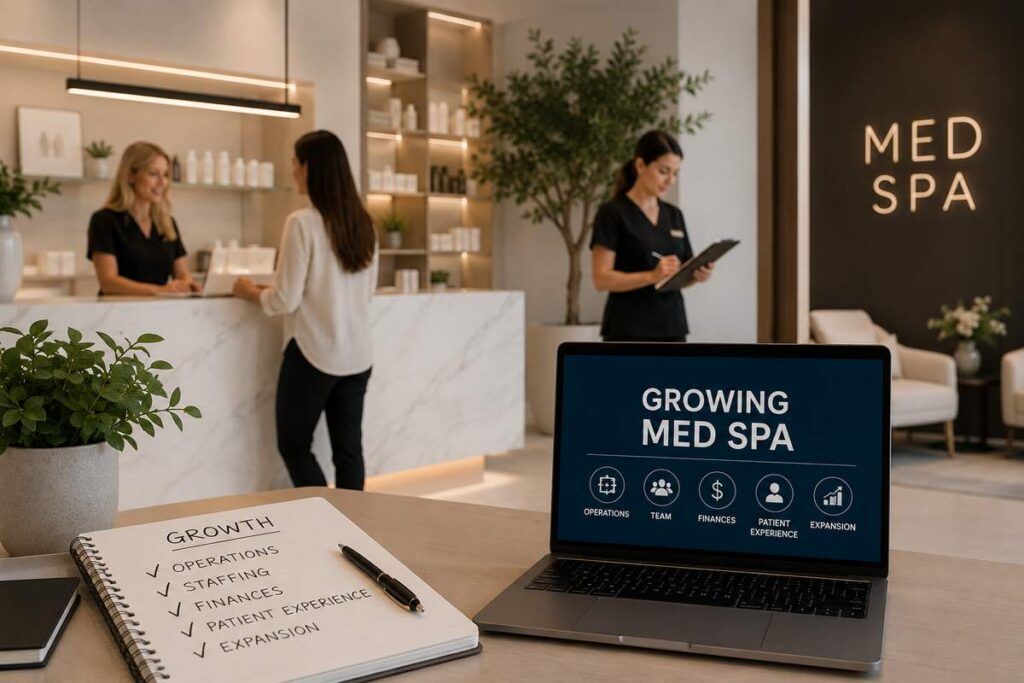
The med spa industry has changed significantly in recent years. More people are interested in aesthetic treatments, wellness services, skin care, and other non surgical procedures. This growing demand has created exciting opportunities for med spa owners.
A med spa that works well with a small team can become much more complicated as the number of patients, employees, services, and locations increases. What once felt simple can quickly turn into a business that requires stronger leadership, better organization, financial awareness, and a clear direction.
Many med spa owners begin with a strong passion for aesthetics and patient care. As the business grows, they may find themselves spending less time doing what they originally enjoyed and more time dealing with employees, finances, operations, marketing, scheduling, and business decisions.
Understanding these challenges is an important part of recognizing what a growing med spa business really requires.
Growth Changes the Role of the Owner
One of the biggest changes that happens as a med spa grows is the role of the owner.
In the beginning, the owner may be involved in almost every part of the business. They may see patients, manage employees, speak with vendors, review financial information, handle customer concerns, and make daily decisions.
As the med spa becomes larger, the same approach can become difficult to maintain. More patients mean more appointments. More employees mean more management responsibilities. More services mean more operational decisions.
This creates an important business challenge. The owner may have built a successful med spa, but the business can become heavily dependent on their personal involvement.
Growth requires a shift in thinking. The owner is no longer simply responsible for delivering excellent treatments. They are also responsible for leading a growing organization.
This transition can be difficult, particularly for physicians and medical professionals who were trained primarily around patient care rather than business leadership.
The larger the business becomes, the more important leadership, delegation, communication, and decision making become.
Maintaining Quality While the Business Expands
Growth can create pressure to serve more patients, introduce additional treatments, hire more employees, and potentially open new locations.
At the same time, patients still expect the same level of service and professionalism.
A business may have a strong reputation because of its personal service, experienced providers, welcoming environment, and attention to detail. When the business grows, maintaining that experience across a larger team becomes more complicated.
Every employee represents the brand.
Patients notice everything from their first interaction with the front desk to their consultation, treatment, follow up, and overall experience. A small difference in service quality can affect how patients view the entire business.
Growth also means that the owner may not personally oversee every patient interaction anymore.
Some of the areas that can become challenging include:
• Patient communication
• Appointment management
• Staff performance
• Treatment experience
• Customer service
• Brand consistency
• Internal communication
• Patient retention
The challenge is not simply getting bigger. It is growing while protecting the reputation that helped the business succeed in the first place.
Managing People Becomes More Complicated
Employees are one of the most important parts of any med spa, but managing a growing team can become one of the most difficult responsibilities for an owner.
A small team may communicate easily. Everyone may understand their responsibilities, know what the owner expects, and work closely together.
Different personalities, experience levels, responsibilities, schedules, and expectations can create challenges. Hiring more people does not automatically solve these problems.
A growing med spa needs people who understand their responsibilities and can operate effectively without requiring constant direction. Owners also need to think about how managers and team leaders fit into the organization.
The aesthetic industry depends heavily on trust and patient relationships. Hiring someone simply because they have experience does not necessarily mean they will fit the culture or represent the business properly.
Employee turnover can also affect patient experience, team morale, and business performance.
As a med spa grows, people management becomes a business responsibility rather than something the owner can handle informally.
Financial Decisions Become More Important
Revenue growth can look impressive, but revenue alone does not tell the complete story of a med spa’s financial health.
A growing business can have more patients and higher revenue while still facing financial pressure.
Expenses increase as a business expands. Payroll, equipment, supplies, rent, technology, marketing, administrative costs, and other expenses can all affect profitability.
The introduction of new services can create additional financial decisions as well. A service may be popular with patients, but popularity does not automatically mean it is beneficial for the overall business.
Med spa owners also need to think about the relationship between growth and profitability.
Important business questions may include:
• Is the business growing in a financially sustainable way?
• Are operating costs increasing faster than revenue?
• Which areas of the business are performing well?
• Is expansion creating additional financial pressure?
• Is the current business model prepared for future growth?
These questions can become increasingly important as a med spa moves from a small owner operated business into a larger organization.
Financial management is therefore not only about watching revenue. It is about understanding the bigger picture behind the numbers and making decisions that support the long term direction of the business.
Expansion Creates a New Level of Complexity
Opening a second location can be an exciting milestone for a successful med spa.
What works in one location may not automatically work in two or three locations. Owners have to think about leadership, staffing, communication, patient experience, operations, finances, and brand consistency across the organization.
This is where many growing businesses discover that expansion requires more than simply finding another building and hiring additional staff.
Multi location growth also changes the way an owner views the company. Instead of managing individual daily activities, the focus increasingly moves toward the performance of the overall organization.
Expansion can create opportunities, but it also increases the consequences of poor business decisions.
A business that is prepared for growth can approach expansion with greater confidence. A business that grows without the right leadership and organizational foundation may find that growth creates more problems than opportunities.
Conclusion
Growing a med spa is an exciting achievement, but it also brings challenges that are very different from those faced by a smaller practice. Leadership responsibilities increase, maintaining quality becomes more difficult, managing people requires greater attention, financial decisions become more important, and expansion introduces another level of complexity.
For physicians and med spa owners who want experienced guidance as they navigate these challenges, Dr. Alex Spinoso brings real world experience in medical practice growth, aesthetic business strategy, healthcare leadership, and physician entrepreneurship. My experience working with growing medical businesses allows me to provide an informed perspective for leaders who are ready to take their business to its next stage.